Are the cloud tops too bright?
A grounded check of the standalone Bonkahe→three.js cloud port (atmo=0), prompted by one observation: the sunlit cloud tops look bleeding bright. This page answers it with measured pixels, a math view, eight fly-through GIFs, and a neutral team read — no guessing.
The answer, measured: yes — the sunlit crowns clip to pure white, but it's vantage-specific. Looking down at the fully-lit tops, 11–20% of the frame pegs to white (byte 255). From the side, below, or distance the same clouds never exceed luminance ≈204 and don't blow at all.
Cause (team, high confidence): not the tonemap (that's a verified-faithful copy of Godot's filmic). The in-scatter light accumulation sums each step raw — no transmittance weighting, no normalization — so a fully-lit crown over-accumulates past the tonemap's white point (which sits at 1.0 with zero headroom) → clip.
1 · The math view — where it blows, in motion
Luminance measured in display space (sRGB, the value your eye reads). A pixel is “blown” when luminance ≥ 250/255. The clip-map repaints every blown pixel red, so you can watch the crowns flare exactly when the camera faces the lit tops — and stay clean otherwise.
Toggle each between the normal render and the clip-map. Red = clipped to white (form lost); grey = still holding detail.
Measured luminance by vantage (worst frame on each route, display sRGB, real GPU)
| Vantage | mean L | max L | blown ≥250 | blowout |
|---|
2 · The feel — eight fly-throughs
~12-second loops, real GPU, atmo=0, from all around the cloud field. Each carries a blind-critic read (neutral brief — they were not told to look for brightness).
3 · Atmosphere on vs off
The same deck view, atmospherics on vs off. Atmosphere halves the blowout (deck 11.5% → 4.8%) by mixing the crowns toward haze before tonemapping, so the brightest lobes keep a highlight rolloff instead of going to paper-white. It's a mitigation, not a fix — the crown still rides near the ceiling and re-clips under a hotter sun. atmo=0 (the version of record) is the brighter, more-blown one.
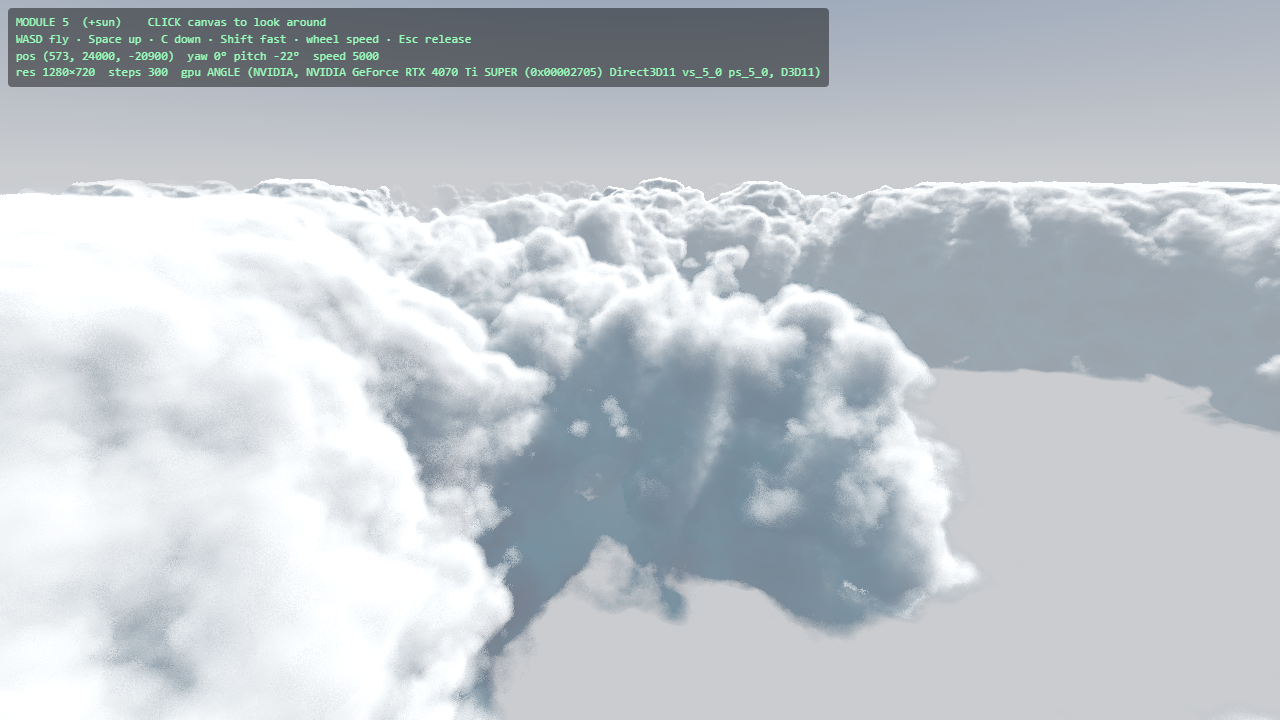
Crisper, but the lit tops clip.
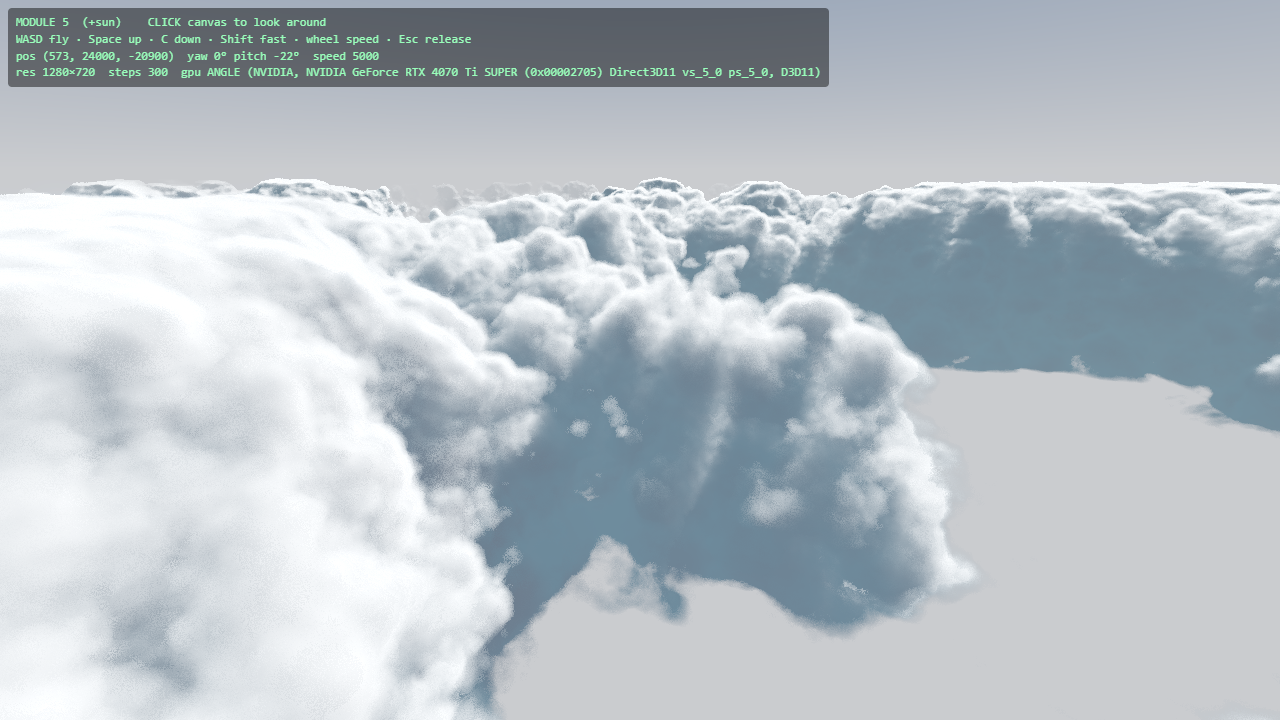
Milkier/lower-contrast, but the crowns hold form.
4 · Root cause & what could fix it
The team ran two math lanes (tonemap + lighting) and four blind visual lanes, neutral briefs, no poison. They converged:
- Tonemap — faithful, innocent. Godot-4 filmic, verified byte-for-byte (0.9→250, 1.0→255). Its white point sits at linear 1.0, so it has zero headroom: any input ≥0.99 → byte 255. Correct curve; it just receives an over-cooked value.
- In-scatter accumulation — the likely divergence (
index.html:380). Each march step on a lit, low-density crown deposits ~0.9–1.0 linear and the loop sums it raw — not weighted by remaining transmittance, not divided by sample count — so a crown reaches linear ≈ 2–5. That's what overruns the tonemap. - The open fork (medium confidence on locus). Is the crown's HDR value genuinely ~1.0–1.3 (then it's faithful — Godot would clip identically and the fix is exposure) or ≫2 (then our accumulation runs hotter than Bonkahe's and line 380 is the fix)? A saturated PNG can't tell us — the HDR magnitude is hidden behind the clamp.
Decisive next test (settles bug-vs-faithful, no guessing): read the linear HDR buffer at a known-blown crown texel (the port can output linear via the bloom pass) — is it ~1.3 or ≫2? — and check Bonkahe's SunshineCloudsCompute.glsl for whether his in-scatter weights by transmittance. That one fact picks the lever.
Options if we want to reduce it (your call — not picking one)
exposure_bias=2.0) so HDR ~1–1.5 lands below white and crowns roll off. Cheap, reversible, faithful-safe — but lifts/darkens the whole frame, not just crowns.atmo path) so crown linear tops out ~1.0–1.3. Most surgical; risks flattening highlight variety if overdone.5 · Honest limitations
The blind critics flagged more than brightness — recorded straight, not buried:
- Above (looking down) is the only genuinely convincing view: cauliflower lobes, self-shadowed crevices, soft silhouette — and it's exactly where the crown clips.
- Inside and flyby read weak: flat grey-white wash, a hard sun disc with no scatter halo, and gritty salt-and-pepper noise where the cloud thins (the form dissolves into pixels instead of soft falloff).
- Outside / distant is near-empty — no cloud mass reads at range.
- Below is pretty but soft — the underside is smooth painted haze, missing the lobed volume the top has.
So brightness is one finding; edge-noise, the sun disc, and distant-mass are separate threads if we keep going.
Built from real-GPU captures (NVIDIA RTX 4070 Ti SUPER, D3D11). Luminance/clip measured per pixel in display sRGB (qa/tools/measure_brightness.py); GIFs assembled with ffmpeg two-pass palette. Evaluation by a 6-agent neutral team — two math lanes, four blind visual lanes, two-directional briefs, no poison. Findings are measurements and reasoned reads, not a beauty verdict; the CD's eye decides direction.
Cloud port: research_clouds/threejs-port/ · scope: diagnose, not fix.